The history of the ORIGINAL singing group, 1962-65.
Told by founding member, Ernie Bringas.
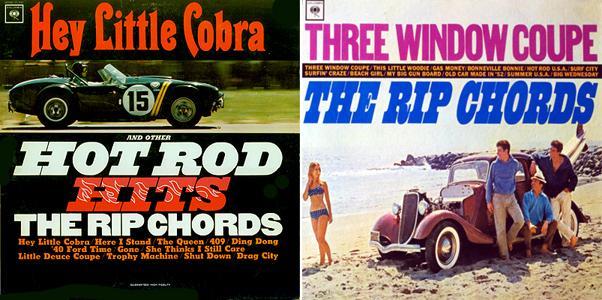
This is the story of the vocal group The Rip Chords. The music of The Rip Chords was recorded from 1962-1965 at Columbia Records in Hollywood, California. We placed five singles on the Billboard Hot 100 and also produced two albums for a total of 33 recordings. Our moderate successful breakout record of “Here I Stand” paved the way for our best known mega-hit, “Hey Little Cobra.” It all began in 1957.
ABOUT ERNIE
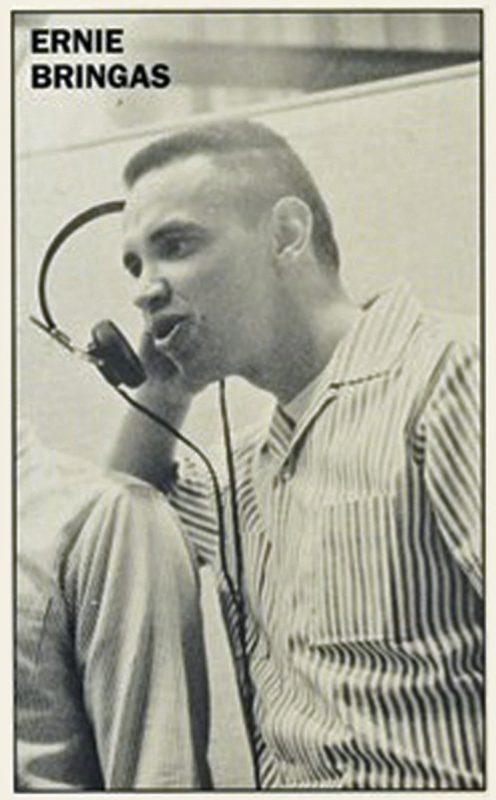
My name is Ernie Bringas, and I was one of the two founding members of The Rip Chords – the other being my business partner, Phil Stewart (1938-2013). Our group expanded to four when Columbia producers, Terry Melcher (1942-2004) and Bruce Johnston joined us.
Later in life I served as a United Methodist minister in California for almost twenty years, which is important to this story, as you’ll soon see. Then I taught religious studies at Glendale Community College as an adjunct faculty member of the Maricopa Community Colleges (Phoenix area) for twenty-one years, and am now retired.
Below you will find my video explaining all this in my own words, followed by the text of how The Rip Chords started and who sang on what.
The Video – In Ernie’s Own Words
The video below is a documentary of this story in my own voice. I even sang a few parts so that you can hear my voice on the original recordings. Please view the video, then continue on below to read the details.
The Story of The Rip Chords video can be watched as an embedded video above, or you can see it on YouTube directly at: https://youtu.be/THQuvWyAMtc
THE RIP CHORDS – BEGINNINGS
Misinformation and Disinformation
Misinformation and disinformation about the Rip Chords abounds, especially on the Internet, and specifically in terms of who we were and who actually recorded our body of work. For example, a website called classicbands is misleading and flat-out wrong; that’s because the individual they are interviewing never recorded with the ’60s Rip Chords. Furthermore, numerous books, articles, and CD booklets, written on the basis of hearsay over the past decades, are equally misleading.
The following real-life account below is written to clarify the historical record; it must not be sacrificed for expediency, personal gain, pride, or any other reason. To the extent that this is humanly possible—since no account is infallible—the end goal herein is to reflect the greatest approximation of the truth.
An Eye-Witness Account
Succinctly stated, the original Rip Chords (Phil Stewart and I) expanded into four primary voices (adding Columbia producer, Terry Melcher and co-producer, Bruce Johnston). Within this coalition of four, the Rip Chords music would be hammered out. Terry and I would handle most of the lead vocals, but Terry was our best lead vocalist and carried the lion’s share. Bruce and I would handle the falsetto parts. Phil’s deep-ended voice would add the needed bottom. All four voices, in most cases, would contribute to the background vocals. That’s the short of it. But how did all this happen? The answer is a bit more complicated.
Phil Stewart and Ernie Bringas
The story begins with Phil Stewart and me. Just out of high school, Phil and I started singing together in 1957. We recorded a demo record with the help of Ray Pohlman, a studio-musician with The Wrecking Crew. We submitted that demo to many companies, and in 1962 were asked to audition with actress Doris Day’s recording company, Daywin. That sent us on to audition at Columbia Records for record producer, Terry Melcher. He accepted us as his “first” project.
Terry Melcher
At that time, the scuttlebutt was that twenty-year-old Terry Melcher had acquired his position at Columbia with the help of his very influential mother, actress/songstress, Doris Day. Whatever the case, Melcher’s ensuing success he owes only to himself. He became one of Columbia’s most innovative and successful producers. Aside from the Rip Chords, he would go on to produce such groups as the Byrds, Paul Revere and the Raiders, and, much later (for another label) the Beach Boys hit record, “Kokomo.”
HERE I STAND – THE RIP CHORDS’ FIRST RELEASED SINGLE
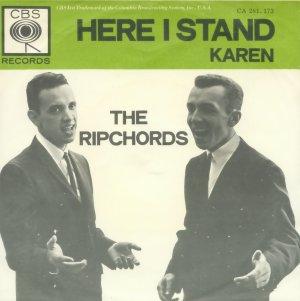
Phil and I (the Rip Chords) recorded our first single, “Here I Stand,” in December of 1962. The song was released in March of 1963. We are the sole vocalists on this recording. Terry, our producer, wanted a unique sound for our first record. He knew I had vocal versatility so he asked me to sing the lead, and then he had me overdub multiple falsetto and harmony parts to create the choral effect he wanted. Phil sang the needed underlying bass part.
Listen to the Rip Chords’ first single: Here I Stand
As already noted, our producer was the legendary Terry Melcher and he was at the very beginning of his career. Although Phil played the acoustic guitar, he was not a professional.
We were strictly a vocal group. Therefore, the instrumental tracks were provided by a renowned group of studio musicians (known as the Wrecking Crew).
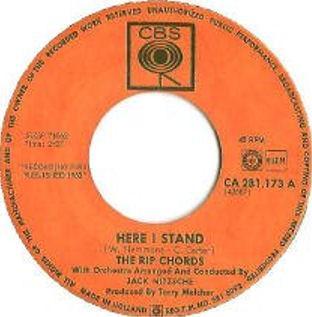
These topnotch musicians included a young guitarist by the name of Glen Campbell (1936-2017). His guitar lick provided the driving musical hook for “Here I Stand” – you can’t miss it on the original release although it’s been watered down in subsequent remixes. (When someone remixes they generally produce a different version of an original recording by altering the balance of the instrumental and/or vocal tracks.)
“Here I Stand” was a good and necessary showing for a first release. To say that this was a failed release, as some sources claim, is inaccurate. “Here I Stand” had moderate success, peaking nationally at #51 but reaching the Top 20 in some major markets (e.g., KFWB and KRLA in Los Angeles, WQAM in Miami, WLS in Chicago).
“GONE” – THE RIP CHORDS’ SECOND RELEASED SINGLE
On our second release, “Gone,” (May, 1963) Phil and I were joined vocally by Bruce Johnston, a good friend of Terry Melcher. Phil, Bruce and I were the only three vocalists on this recording. I am singing the lead vocal.
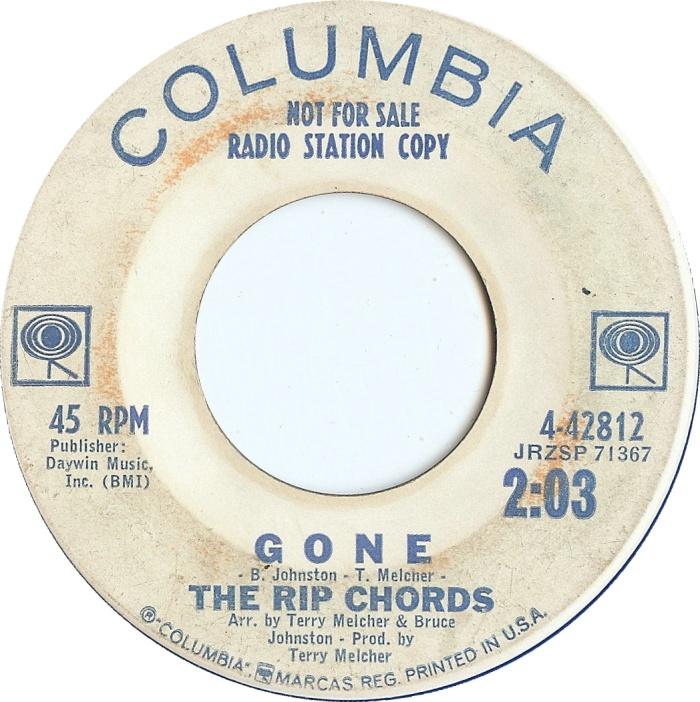
Listen to their second single: GONE
The audio below highlights Bruce’s high-pitched falsetto. I believe that Bruce has one of the best falsetto voices in pop music, especially at the very high-end of the vocal spectrum. Bruce’s falsetto is clearly heard in this tail ending of “Gone”… Incidentally, Bruce Johnston eventually became a member of the Beach Boys after the Rip Chords disbanded.
Listen to this example of Bruce’s high falsetto:
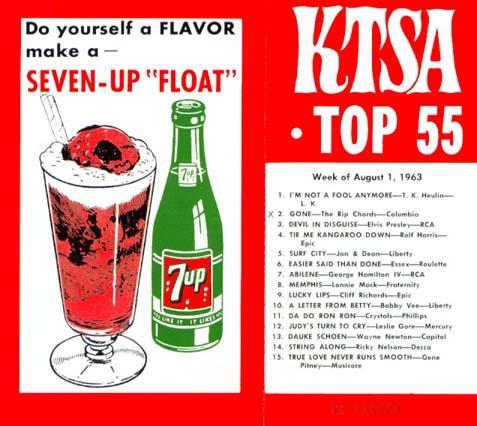
In spite of Bruce’s contribution, “Gone” did not fare as well as its predecessor, although it did hit the national charts. For whatever reason, “Gone” did not receive universal exposure. But in the geographical markets where it drew airplay, it went to the top of the charts. For example, during the week of August 1, 1963, in San Antonio, Texas, “Gone” climbed up to #2, right above Elvis Presley’s #3 song, “Devil In Disguise.” (See image of KTSA Top 55.)
ERNIE’S SHORT SEMINARY BREAK
At this point in time, I had just graduated from California State University, Long Beach. I was now ready to begin my ministerial studies at United Theological Seminary in Dayton, Ohio (a three-year college that prepares students for ministry). Attending seminary would not be a problem; I could always fly back to Hollywood for the recording sessions. That was the plan.
However, touring on the road was another problem altogether. If I were in school, who would tour with Phil as the Rip Chords? Here’s the history leading up to my three month absence.
Duo Appearances Before Seminary
Prior to this complication, Phil and I had made several appearances for promoting ourselves. Columbia Records had us out and about even before, and certainly after, our first released single, “Here I Stand.”
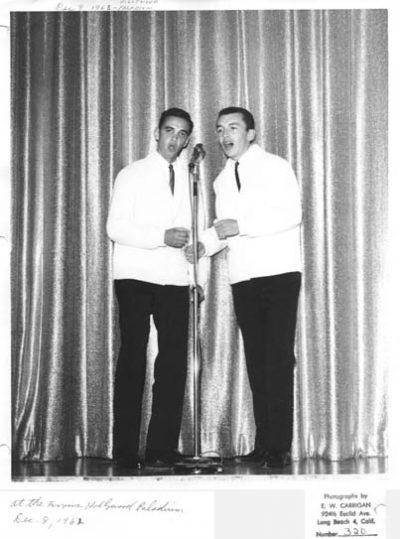
We made several TV appearances and did a few shows around the L.A. and San Francisco areas. A charity performance with the Tommy Dorsey Band was a special highlight. Also, our performance at the prestigious Hollywood Palladium was most memorable. But now that I was headed for seminary, it was clear to everyone that Phil couldn’t walk out on stage by himself; after all, one person does not constitute a singing group.
The Church’s Decision
There was yet another much more serious problem that arose. The conservative officials of my church denomination (Evangelical United Brethren Church), were not very pleased with my rock & roll involvement. They strongly suggested that I get out of the business. They believed I should not, in a manner of speaking, serve two masters. If I refused, they would suspend my ministerial license, and block my entrance into seminary. This was a predicament. I did not want to give up my educational and ministerial pursuits. Reluctantly, I agreed, for the moment. But this left my partner, Phil, with a double whammy! Who would tour with him? He couldn’t walk on stage by himself. More importantly, who would record in the studio with him?
Touring Problem Solved
The touring problem was solved by hiring two young men (Rich Rotkin and Arnie Marcus) to join Phil on stage. Their job was to tour with Phil on the road as the Rip Chords. Importantly, Rich and Arnie were never under contract to record and, consequently, they do not appear vocally on any ’60s original Rip Chords recordings. With the exception of Phil, therefore, the touring Rip Chords were not the real McCoy. This reminds me somewhat of Milli Vanilli, the German R&B duo from Munich who got into hot water because they had not recorded any of the vocals heard on “their” records. (For further clarification on our touring anomaly, please see the addendum at the end of this article.)
Recording Problem Solved
The recording problem was solved in-house. Obviously, Phil as a lone vocalist did not constitute a recording group. Therefore Terry Melcher (the Rip Chords producer) and Bruce Johnston (who had sung on “Gone” and was now co-producer) stepped in to fill the void created when I departed for seminary. Thus, the recording group now, and temporarily, consisted of Phil, Terry, and Bruce.
Once again, it is important to remember the following throughout this writing: With the exception of Phil, the touring group and the recording group were two distinct, separate entities. Unfortunately, this improper solution would eventually cause a great deal of confusion about our legacy (more on this later).
“HEY LITTLE COBRA”– THE RIP CHORDS’ THIRD RELEASED SINGLE
It was also during this critical period that Melcher and a young songwriter named Carol Conners collaborated on a song called “Hey Little Cobra.” Recognizing the song’s potential, Melcher called for a Rip Chords’ recording session.
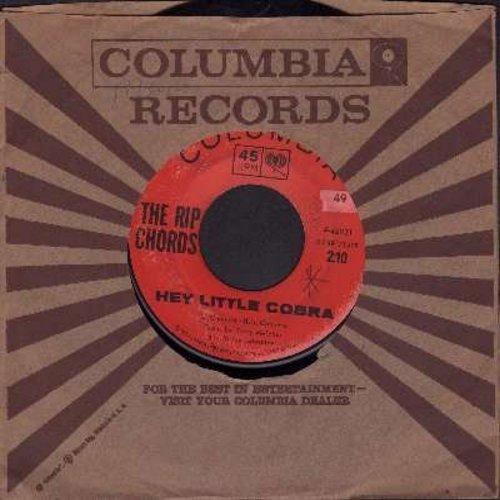
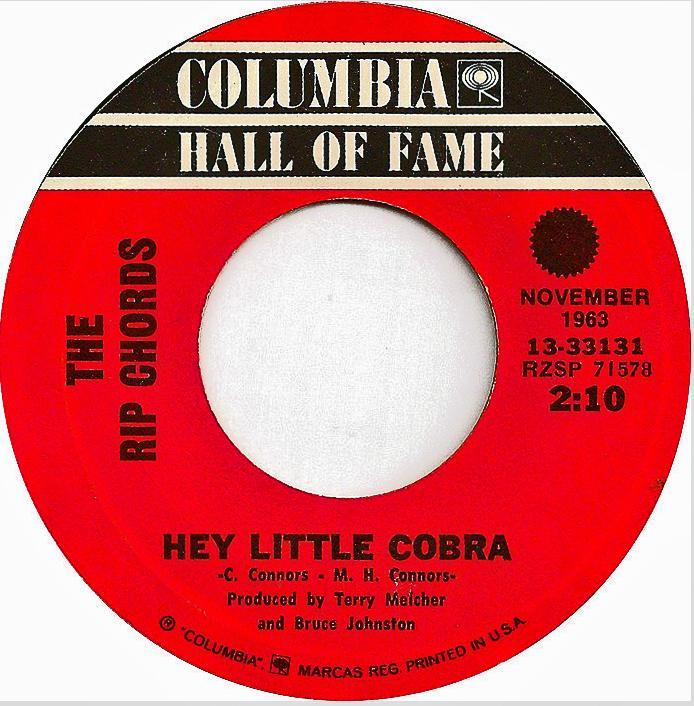
Prior to this event, Melcher did not consider himself a vocal talent (although vocally he had already experimented somewhat at Columbia). But as it turned out, his lead vocal on “Hey Little Cobra” was outstanding. He not only discovered his voice, but he also discovered he had a great “sound” (the equivalent in photography of being photogenic).
The Legal Group Was Still The Original Duo
So Terry Melcher, the producer, writer, and arranger, had also become Melcher, the singer. But he was singing for a group of which he was not a member. (Phil and I were the only Rip Chords legally under contract to Columbia.) As a consequence, Terry never received his well-deserved recognition as a vocalist (at least not until recently). The same is true for Bruce Johnston, who does the falsetto on “Hey Little Cobra.” The song peaked at #4 nationally in early 1964. (Both Terry and Bruce were paid as Columbia producers.)
ERNIE RETURNS TO THE STUDIO
After having been at seminary and away from the Rip Chords for three months, I received a call from Phil asking me to please rejoin the group. I wasn’t sure that was possible, but I pled my case to the bishop of my church (W. Maynard Sparks, 1906-1999). He, in turn, helped overturn the former ruling of church officials that had barred me from recording. I was free to return to the group, provided I restrict my involvement to recording and refrain from touring with the group (as this might detract from my theological studies).
The Three Month Absence Is Over
With this understanding, I ended my three-month absence from the group. (I had left in September of ’63 and returned in late November of ’63.) I REJOINED THE RIP CHORDS!!! Sorry for the emphasis here but this key factor is what most rock & roll pundits and Internet sites overlook. At this point in time, we hadn’t even started recording the Hey Little Cobra and other Hot Rod Hits album, not to mention all our other recordings that came thereafter (including the “Three Window Coupe” single and album that was yet to follow).
As I mentioned earlier, I was still restricted from touring. As a consequence, Rich Rotkin and Arnie Marcus continued to tour with Phil Stewart on the road in Milli Vanilli fashion.
HEY LITTLE COBRA AND OTHER HOT ROD HITS – THE RIP CHORDS’ FIRST RELEASED ALBUM
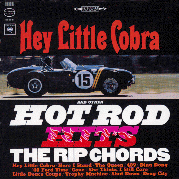
n December of 1963, we recorded the entire Hey Little Cobra and other Hot Rod Hits album; I was on semester break from seminary. Aside from a couple of solos and two instrumentals from our studio musicians (the Wrecking Crew), the album featured a good smattering of all four vocalists (Terry, Bruce, Phil and me). Again, these are the only four voices that comprised the entire Rip Chords recordings of the 1960s.
“THREE WINDOW COUPE” –
THE RIP CHORDS’ FOURTH RELEASED SINGLE
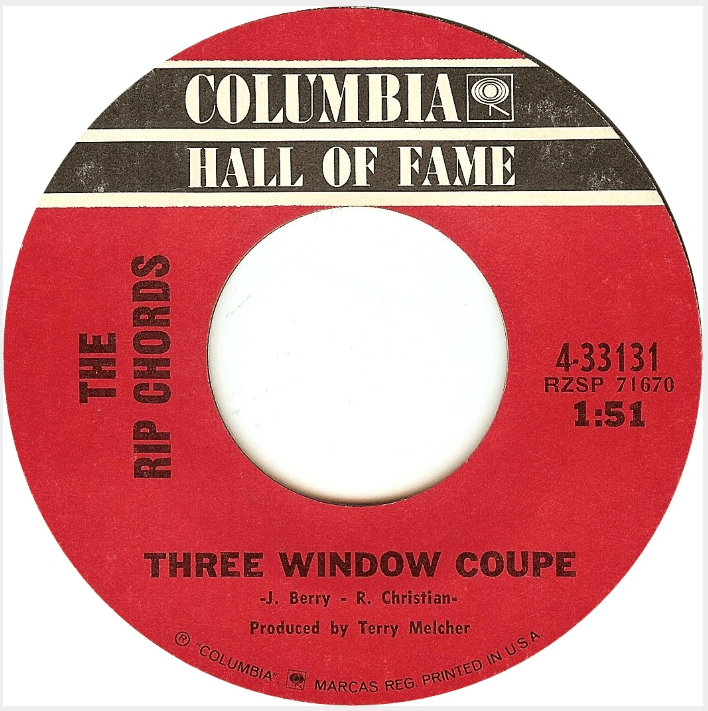
Following the success of the “Hey Little Cobra,” single and the follow-up Cobra album, Terry Melcher selected another song for our next release. Before heading back to seminary in Dayton, Ohio—I was still on semester break—we were back in the studio at Columbia in January of 1964; the end result was our next single, “Three Window Coupe.” By April of that same year, although not quite as successful as the previous “Cobra” single, it nevertheless scored in the top third of the Billboard Hot 100. This paved the way for what I believe to be our best, united effort.
THREE WINDOW COUPE –
THE RIP CHORDS’ SECOND RELEASED ALBUM
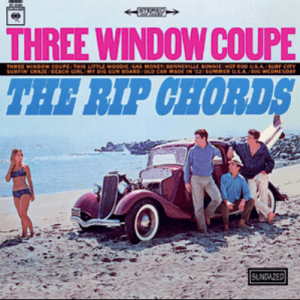
It was April/May of that same year (1964) when I received a call from Terry. He wanted me back to help record the Three Window Coupe album. I was at the end of my first year in seminary and I was still facing finals, but I received permission from my professors to fly back to Hollywood for the recording session. That was a marvelous time and I think this album was extraordinary. When all four voices were present, the sound was incredibly rich. We recorded late into the nights. The Three Window Coupe album is a good example of what came to be known as the “California Sound.”
THE CALIFORNIA SOUND
The California Sound had a unique vocal signature, not easily deciphered. Terry had a very creative recording technique by which vocal parts were not simply duplicated (overdubbed) by the same person, but sometimes duplicated by different voices (cross-overdubbed). In fact, many of the background harmonies were repeated by one or two of the other singers, making it virtually impossible for an outsider to distinguish who was singing what. Even some lead vocals were recorded in this manner, as was for example, the composite leads of Terry and me on “My Big Gun Board.” Incidentally, I consider “My Big Gun Board” to be one of our best recordings because of its overall vocal balance between the four parties and, because of its superb melody. I lobbied for its release as a single, but to no avail.
Listen to the two-voice-‘composite’ of Terry Melcher and Ernie Bringas
To be sure, neither Phil nor I deny that Terry and Bruce were the major contributors in shaping the Rip Chords’ music and to what is now known as the “California Sound.” It was Terry and Bruce who took the checkered flag in their asphalt single, “Hey Little Cobra.” Not only was that our greatest hit, but that sound became our hallmark signature.
However, in my opinion, the California Sound was never so vibrant and expressive as when all four of our voices registered their influence, which was on most of the recordings. Neither Phil nor I, as a duo, nor Terry and Bruce as a duo (who later recorded their own music under the moniker of Bruce and Terry), ever recaptured the marvelous sounds of all four voices as found on the Rip Chords’ albums, especially the Three Window Coupe album.
THE BREAKUP
We released one additional single after the Three Window Coupe album. Frankly, because of my educational responsibilities, I was not able to fly back from seminary for that recording. Anyway, the outcome was inconsequential as it failed to break into the Hot 100. There were other indications that suggested it was time to call it quits at Columbia Records.
As noted above, Terry and Bruce sought their own claim to fame by starting their own group. But their success as a duo was not to be. Predictably, however, this divisional distraction was counterproductive. The old axiom that “a house divided against itself cannot stand,” proved true. The breakup of the group, in any case, would have been inevitable.
The Ministerial Calling Remained
Personally, I had already made a conscious decision to pursue my ministerial calling rather than my recording career. Bruce was being courted by the Beach Boys (which he eventually joined). Terry had his hands full producing other Columbia artists, and Phil was leaning toward Country & Western (his true love). We all seemed willing to move in these different directions. This is not to imply that at some points along the way, hard feelings did not ensue. We were all a bit self-centered and headstrong in our younger day. But I don’t believe any of us set out to hurt anyone, or deprive anyone his rightful place. Whatever the case, all four of us share responsibility for the group’s decline.
Looking back, I know we didn’t achieve our full potential as a group. We didn’t get it all, but I’m grateful and satisfied for what we did accomplish, and, when I say “we,” that includes all four singers. But I cannot close this narrative without reiterating the importance of Terry Melcher and Bruce Johnston. Without them, one wonders at the outcome. Shortly before Terry’s lost battle against melanoma, I had the opportunity to share with him my personal gratitude for the time we shared together, and his talented contribution to our group.
CLARIFICATIONS AND DEBUNKING SOME MYTHS
At the beginning of this document I spoke of the “misinformation” and “disinformation” (false information that is intended to mislead) that has swirled around the Rip Chords’ legacy right from the beginning. Hopefully, my previous comments, along with the following facts, will lay these misunderstandings and misrepresentations to rest. For further clarification, be sure to read the addendum at the end of this article.
THREE MAJOR MYTHS
Aside from the “Hey Little Cobra” single, which I have already credited to Columbia producers Terry Melcher and Bruce Johnston, a major question remains: Who was vocally responsible for the total body of work originally issued by the Rip Chords (a total of 33 recordings from 1962-1965)? Although I think I have already answered that question, I suspect that some added clarification is still necessary. Incidentally, four of those 33 songs (“’40 Ford Time,” “Bunny Hill,” “Big Wednesday,” and “Wiameah Bay”) were instrumentals — instrumentals that were recorded by studio musicians (the legendary Wrecking Crew) who were backing us up instrumentally. Since we were strictly a vocal group, we can’t take credit for those four recordings. Nevertheless, they were incorporated into our body of work as album fillers.
The question remains: Who sang what? For outsiders who contemplate the history of the Rip Chords, there are three monumental myths that must be confronted:
THE FIRST MYTH
The first myth proposes the idea that Rich Rotkin and Arnie Marcus were vocal contributors to the group’s recordings. But as I indicated earlier, this is not true. Unfortunately, they themselves are instigators of this falsehood; their website implies as much. However, as I will soon show, Rich and Arnie do have a partial claim to the Rip Chords story, but only as part of the TOURING group, not the SINGING group.
The Best Of The Rip Chords Album Documents Who Sang On The Recordings
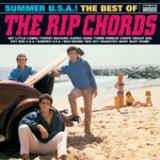
The 2006 Columbia/Sundazed CD release, Summer U.S.A.! The Best of the Rip Chords, says it best:
“NO GROUP EPITOMIZED THE SUN-SOAKED CALIFORNIA SOUND BETTER THAN THE fabulous Rip Chords… Led by legendary producer Terry Melcher along with future Beach Boy Bruce Johnston and ace-vocalists Ernie Bringas and Phil Stewart, these long-board big-guns left an indelible mark on the surf’n strip sounds of the ’60s….” (Album cover is Courtesy of Sony Music Entertainment.)
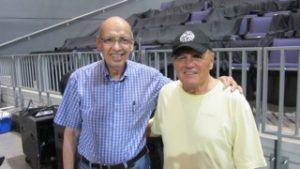
The above comment from Sundazed was also confirmed by my long-ago colleague, Beach Boys’ Bruce Johnston (see photo on the right). I met up with Bruce in July 2012. Bruce agreed and confirmed what is now common knowledge; it was only Terry, Bruce, Phil, and I who recorded the vocals for the original Rip Chords in the 1960s.
THE SECOND MYTH
The second myth proposes that Terry Melcher and Bruce Johnston were solely responsible for all the vocal recordings that followed their debut on the “Hey Little Cobra” single. This misunderstanding originates from the fact that I left for seminary shortly before the “Hey Little Cobra” single was recorded. Proponents of this view are either ignorant of the fact that I returned to the group shortly thereafter, or, they believe that Phil and I were sidelined for the duration. In either case, they’re wrong. With the exception of the “Cobra” single, our vocal imprint is clearly audible on almost all recordings, including the Hey Little Cobra and other Hot Rod Hits album and all other projects thereafter; that is, the “Three Window Coupe” single and the Three Window Coupe album. This whole issue of who sang what, provides a perfect segue to myth number three.
THE THIRD MYTH
The third myth proposes that even if Phil and I were not totally sidelined by Terry and Bruce following my return to the group, our vocal contribution must have been limited or inconsequential. On the contrary, we were all involved with the final product. Not unlike the Borg in Star Trek, we were all ASSIMILATED! It was easier for me than for Phil to make this adjustment. Both Phil and I were capable of doing leads, but I had the advantage of a more versatile rock-oriented voice and a falsetto ability to boot. To be clear:
- Terry sang lead on 16 songs which included 3 released singles,
- I sang lead on 9 songs which included 3 released singles,
- Terry and I sang composite leads on 2 additional songs which included 1 released single,
- Phil sang lead on 4 songs, and
- Bruce did not sing any leads (although his vocal contributions are indelible).
Therefore, any attempt to downplay the vocal contributions of Phil and me, flies in the face of these numerous recordings.
WHO SANG ON THE RIP CHORDS’ SONGS
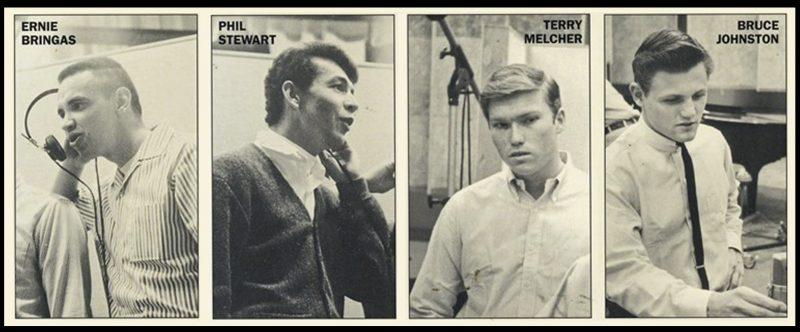
LEAD VOCALS
TERRY’S LEAD VOCALS:
As stated above, Terry had 16 lead vocals for the Rip Chords. Here are some of Ernie’s favorites:
“Hey Little Cobra” – A Bruce and Terry production with Terry on lead:
“Trophy Machine” – Terry is on lead, I’m doing the falsetto, and all of us on background vocals:
“Little Deuce Coupe” – Terry and I are basically alone on this one (he’s singing the lead and I’m singing the falsetto, we’re both doing background vocals):
“Hot Rod U.S.A.” – You can clearly hear Terry with the lead vocal, Bruce with the high falsetto, and all of us on the background vocals:
“Summer U.S.A.” – You can hear Terry on lead and everyone else singing background on this:
ERNIE’S LEAD VOCALS:
I had the lead vocal on nine (9) Rip Chords songs. Of these nine, three (3) were released as singles by Columbia Records:
“Here I Stand“:
“Gone“:
“One Piece Topless Bathing Suit” (Terry and I share a composite lead – our voices are blended together):
ERNIE’S OTHER SIX VOCALS ARE:
“Shut Down“:
“Surfin Craze“:
“409“:
“Gas Money“:
“My Big Gun Board“: Terry and I share a composite lead – our voices are blended together.
“She Thinks I Still Care“
PHIL’S LEAD VOCALS:
Phil had four leads. You can clearly hear his different vocal range:
“Bonneville Bonnie“: (Phil wrote this song and he sounds great in my opinion.)
“Karen” (Ernie is singing lead harmony):
“Old Car Made In 52”
“Ding Dong Baby”
Furthermore, all four singers (Terry Melcher, Bruce Johnston, Phil Stewart, and I) were fully engaged with various contributions on almost all recordings (the Hey Little Cobra” single being the most memorable exception). For example, Phil’s baritone/bass parts can hardly be missed through-out.
FALSETTO
As for falsetto, I’m everywhere and so is Johnston. I’ve included selections of songs below so that you might distinguish our voices, and compare those with the blended falsetto of both Bruce and me.
ERNIE’S FALSETTO:
My falsetto appears alone on:
“Here I Stand”:
“Shut Down”:
“Ding Dong Baby”
“Drag City”
“Trophy Machine”
“Little Deuce Coupe“:
“She Thinks I Still Care” – As I mentioned earlier, Phil and I were the original Rip Chords. Here is what we sounded like together. I’m singing lead and falsetto and we’re both doing all the layered background vocals:
BRUCE’S FALSETTO
Johnston’s falsetto appears alone on:
“This Little Woodie” – Listen to Bruce’s beautifully soft falsetto on this:
“Hey Little Cobra“:
“The Queen“:
“Surfin Craze“:
“Hot Rod USA“:
COMBINED FALSETTO OF BRUCE AND ERNIE
But sometimes our falsetto voices were combined (partial list below).
“Three Window Coupe“:
Also:
“Surf City”
Portions of “Beach Girl”
ADDENDUM: THE NEW RIP CHORDS
In the mid 1990s the group was revived. But none of the original singers were part of this new configuration. This new group is comprised of seven or more members (off and on) two of which are Rich Rotkin and Arnie Marcus. If you’ll remember, back in the ’60s, Rich and Arnie were hired to go on tour with my partner Phil Stewart because, aside from Phil, the other three singing Rip Chords were unavailable to tour. (Terry Melcher and Bruce Johnson were busy as Columbia producers, and I was pursuing my seminary education.)
COLUMBIA’S MARKETING NEEDS
Although Rich and Arnie do not appear vocally on any of our recordings, Columbia’s powerful marketing machine successfully promoted them (along with my partner Phil Stewart) as being the Rip Chords. Obviously, this was all done for the sake of expediency (an action that is convenient and practical, although possibly improper). With the exception of Phil, the touring Rip Chords were not the real McCoy. Again, this reminds me somewhat of the Milli Vanilli touring group I spoke of earlier.
Be that as it may, this makeshift tour group appeared on Dick Clark’s American Bandstand and toured with him on his Caravan of Stars. They also appeared in a Hollywood movie, A Swinging Summer. Columbia promoted their names and pictures on all advertising campaigns and product; that is, interviews, publicity shots, magazines, album covers, and so forth. Therefore, Rich and Arnie’s names and photos (through no fault of their own) continue to surface on every reissued product since the 1960s.
BEFORE AND AFTER 1965
It’s no secret that Rich Rotkin and Arnie Marcus have taken advantage of this misdirected publicity by starting up the new Rip Chords in the mid 1990s and passing themselves off as the “original” recording group of the ’60s. Is it any wonder that people are confused about the Rip Chords identity? Hopefully, my previous comments will help clear up this confusion.
Having said this, however, Ernie felt that Rich Rotkin and Arnie Marcus have a reasonable claim for being part of the Rip Chords even though they made no vocal contributions on our recordings.
APPRECIATION FOR RICH AND ARNIE:
- First, Rich and Arnie made it possible for Phil to go on tour without Ernie. It allowed the recording Rip Chords to have representation in the field. They became the touring wing and the extension of our recording group.
- Second, we must remember that Rich and Arnie were brought in to fulfill touring responsibilities. They were never part of the recording group. This had to be difficult and awkward for them. I can’t imagine it. They certainly paid their dues while holding up the front and center duties of touring.
- Third, by reviving the Rip Chords in the 1990s, Rich and Arnie have helped to put the group back on the “oldies but goodies” map. They tour extensively and, therefore, help to promote and continue the Rip Chords legacy, even though it perpetuates confusion about who sang on the original songs.
CAVEAT (BUYER BEWARE):
Since their formation in the ’90s, the new Rip Chords have recorded their own songs. The problem today is that the Internet (including Amazon) sells the new recordings of the new Rip Chords along side those of the original ’60s group. This gives the false impression that the new group is simply an extension of the earlier singing group. This is wrong and very misleading; anything recorded after 1965 does not involve or reflect the original singers (Terry Melcher, Bruce Johnston, Ernie Bringas, and Phil Stewart). In short, the Rip Chords have not existed as a singing group since 1965. So when you buy any Rip Chords’ product today, be sure it’s the real thing.
The Story of The Rip Chords video can be viewed directly on YouTube at:
https://youtu.be/THQuvWyAMtc
DISCOGRAPHY
(For convenience, the song title quotation marks were intentionally omitted on all singles listed below.)
ORIGINAL SINGLES
- 1962/63 A-side—Here I Stand (Ernie Bringas on lead vocal) and B-side – Karen (Phil Stewart on lead)
- 1963 A-side—Gone (Ernie on lead) and B-side—She Thinks I Still Care (Ernie on lead)
- 1963/64 A-side – Hey Little Cobra (Terry Melcher on lead) and B-side – The Queen (Terry on lead)
- 1964 A-side – Three Window Coupe (Terry on lead) and B-side – Hot Rod U.S.A. (Terry on lead)
- 1964 A-side –One Piece Topless Bathing Suit (Terry and Ernie on lead) and B-side – Wah-Wahini (Terry on lead)
- 1965 A-side – Don’t Be Scared (Terry on lead) and B-side – Bunny Hill (Instrumental by The Wrecking Crew.)
ORIGINAL ALBUMS
Hey Little Cobra and other Hot Rod Hits – – 1964
(In the order they appear on the original Columbia album)
- Here I Stand (Ernie on lead)
- The Queen (Terry on lead)
- 409 (Ernie on lead)
- Trophy Machine (Terry on lead)
- Gone (Ernie on lead)
- Little Deuce Coupe (Terry on lead)
- ’40 Ford Time (Instrumental by The Wrecking Crew)
- She Still Thinks I Care (Ernie on lead) NOTE: The correct title of this song should have been, She Thinks I Still Care.
- Shut Down (Ernie on lead)
- Drag City (Terry on lead)
- Ding Dong (Phil on lead)
Three Window Coupe – – 1964
(In the order they appear on the original Columbia album)
- Three Window Coupe (Terry on lead)
- Bonneville Bonnie (Phil on lead)
- Gas Money (Ernie on lead)
- This Little Woodie (Terry on lead)
- Hot Rod U.S.A. (Terry on lead)
- Old Car Made In ’52 (Phil on lead)
- Surfin’ Craze (Ernie on lead)
- Beach Girl (Terry on lead)
- My Big Gun Board (Terry and Ernie on lead)
- Surf City (Terry on lead)
- Summer U.S.A. (Terry on lead)
- Big Wednesday (Instrumental by The Wrecking Crew)
SINGLES PREVIOUSLY UNRELEASED
The original albums did not include songs #18-20 found on the Best of the Ripchords CD released in 2006. These next 3 songs were left in the can for decades.
- Wiameah Bay
- Sting Ray
- X.K.E
One song, unreleased by the Ripchords, but performed by the Ripchords, was featured in the movie Swinging Summer with Raquel Welch.
- Red Hot Roaster
Footnote:
This is the official Rip Chords’ website of founding member, Ernie Bringas. This website was first published on June 8, 2003, and is continually updated.
For more information click on this Wikipedia article: The_Rip_Chords.
Tags: The Rip Chords, RipChords, Hey Little Cobra, Ernie Bringas, Terry Melcher, Phil Stewart, Bruce Johnston, Karen, Three Window Coupe, One Piece Topless Bathing Suit
Home – Documentary – Wikipedia – Pictures – Ernie Bringas Author – Homestead & Wolfe